"It's not the end of the story, that wasn't going to be the final chapter," David Singh told Brooklyn Paper this spring, describing the fire that erased a decade of inventory. He was talking about his furniture business. He could have been describing the corridor he chose to rebuild it on.
Here is the thing most Clinton Hill roundups miss. The neighborhood spent years as a place other people's restaurants expanded into, the second outpost of something that started in Manhattan or Jackson Heights or Greenpoint. In 2026 the arrow flipped. Clinton Hill businesses are the ones opening second locations elsewhere, and the storefronts filling in behind them fall into two very different tiers. If you live here and you have noticed that your errand routine feels slightly harder to schedule than it did two years ago, this is why.
The Cafe That Went To Broadway
Choice Brooklyn has anchored 318 Lafayette Avenue since it opened as Choice Market in 2005, building a following on pastries the owners trace back to a family farm in Lot-et-Garonne in southwestern France. This spring, it opened a second shop at 2040 Broadway at West 70th Street, within walking distance of Lincoln Center. Breakfast items start at $4.95 and the sandwiches sit in the mid teens, which is to say the Upper West Side is now paying Clinton Hill prices for a Clinton Hill menu. The Lafayette Avenue original stayed open. The Manhattan store mirrors it.
That is not an isolated case. Mariscos El Submarino arrived from Jackson Heights by way of Greenpoint, opened at 507 Myrtle Avenue last October, and then used that room as the proof point for a Park Slope location at 226 Seventh Avenue in the former Maya Taqueria space. Smør built a Clinton Hill room at 26 Putnam Avenue roughly three times the size of its East Village original, inside a converted warehouse with a skylight, and is now taking its cardamom buns to 361 Court Street. Redwood Hospitality, the group behind Place des Fêtes, Café Mado and Laurel Bakery, keeps opening within a few blocks of itself.
When Michelin dropped its Spring 2026 teaser list of nine new New York spots, five were in Brooklyn, and two of those were on this corridor: Entre Nous, the natural wine room that operates as a sibling to Fort Greene's Fradei, and Los Burritos Juárez on Myrtle, working El Paso and Ciudad Juárez border-style recipes that are genuinely hard to find anywhere in the five boroughs. Neither is an import. Both started here.
What The Turnover Actually Looked Like
The exports came alongside real losses, and it is worth being straight about both.
Moo Burger closed in January after fifteen years. Mekelburg's shut its original Clinton Hill store roughly a year before it closed the Williamsburg one, meaning the specialty grocery that a lot of people used as their babka-and-good-beer stop is gone from the neighborhood entirely.
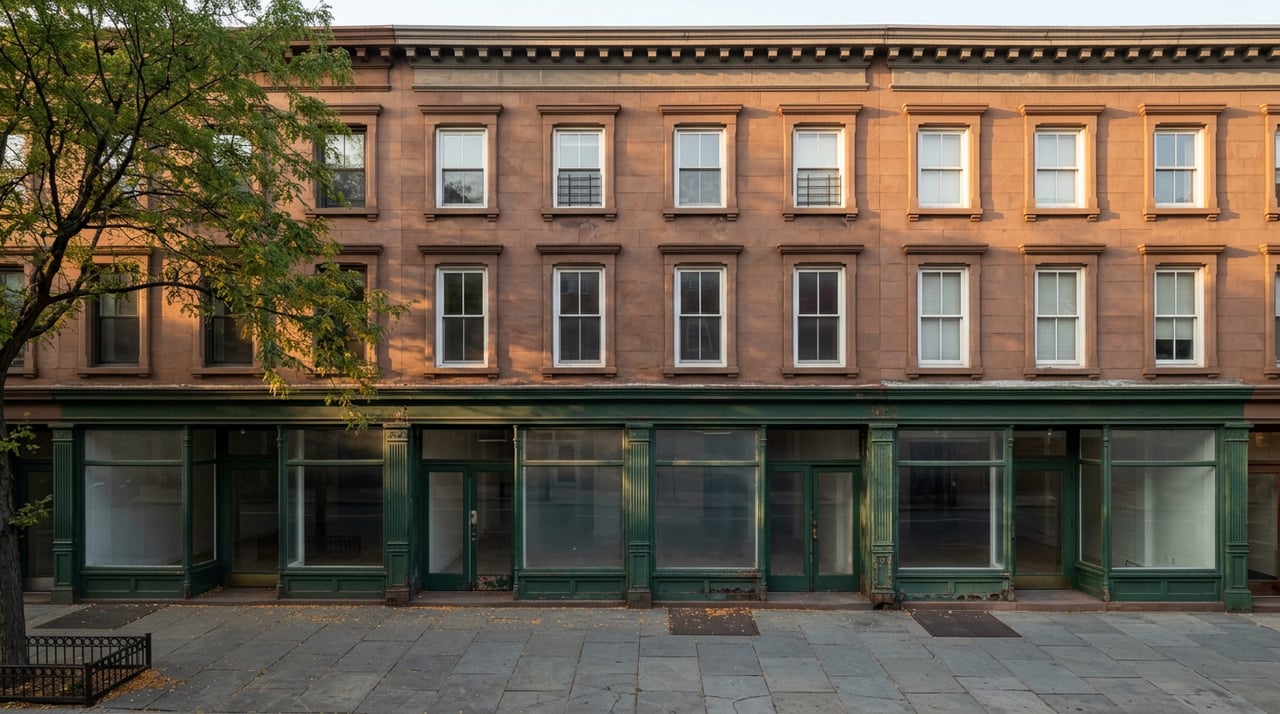
What replaced that square footage is not like-for-like. Porta Coffee opened at 596 Washington Avenue in June, a small espresso counter with a corner to read in, which is a different proposition than a full grocery. And in April, Lanoba reopened at 6 Waverly Avenue in a 9,500 square foot showroom, larger than the Red Hook space it lost.
The Lanoba decision is the clearest signal in the whole year. Lars Noah Balderskilde and David Singh lost more than 900 pieces of Danish furniture, valued around $1.2 million, in the five-alarm warehouse fire on Van Brunt Street last September. A GoFundMe raised more than $62,000. They had originally assumed they would return to Red Hook. They chose Clinton Hill instead, Singh said, because the location works for clients in both Manhattan and Brooklyn, reachable by transit and by bike, with room for the workshop where Balderskilde restores the pieces. They marked the April 11 opening with Danish hot dogs, red sausage and remoulade, because that is what you do in Denmark when a business opens.
The Hours Are The Catch
Now the part nobody puts in a listicle.
Lanoba is open Saturdays and Sundays, noon to four. That is eight hours a week. Los Burritos Juárez is closed Mondays and Tuesdays. During Myrtle Avenue Restaurant Week this February, Mariscos El Submarino ran its prix fixe as lunch only, noon to five, while the other twelve participants ran dinner service.
A lot of the neighborhood's most interesting inventory now operates on deliberately narrow schedules. Chef-owned and owner-operated rooms are running lean, which is a rational response to labor costs and a five-day-a-week clientele, and the practical consequence for a resident is that the good version of your Saturday requires more planning than it used to. If you want to browse a rare Arne Vodder sideboard and get burritos in the same afternoon, there are roughly four hours a week when both of those things are possible.
The Other Tier Coming In
Against that, look at what is signing leases.
A Tous les Jours is headed to 536 Myrtle Avenue. A Ben & Jerry's is opening at 431 Myrtle, on the Fort Greene side of the corridor. Club Pilates opened its Clinton Hill studio on Myrtle last summer. Just past the western edge, Breeze, the Sichuan dim sum favorite from Greenpoint, signed a fifteen-year lease at 590 Fulton Street at the base of The Ashland, planning that room as its future flagship. La Mestiza, a Latin American bakery, is slated for Fort Greene this fall.
Fifteen-year leases and national franchise credit are not what a soft corridor attracts. What you are watching is a commercial strip that can now underwrite two entirely different tenant models at once: the eight-hours-a-week specialist who came here on purpose, and the multi-unit operator who ran the foot traffic numbers and liked them. That combination is unusual, and it is the most durable thing about Myrtle Avenue right now.
The Calendar That Comes With It
The Myrtle Avenue Brooklyn Partnership does the connective work here, and its programming is a reasonable proxy for how many operating businesses the corridor actually has.
Restaurant Week returned for its fifth edition in February with thirteen participating restaurants across Fort Greene and Clinton Hill, running three-course dinners at $25, $35 and $45. The roster reads like a map of the avenue: Third Falcon at 360, Mint Heights at 368, Putnam's Pub at 419, Myrtle Thai at 438, Spice & Grill at 441, Rosticceria Evelina at 455, Osteria Brooklyn at 458, Yamashiro at 466, Lula Mae at 472, Neno's at 499, Castro's at 511. Cambodian, Thai, northern French, Italian, Nepalese and Mexican inside eleven blocks.
In February and March the Partnership ran Black Excellence Now: The Art of Storytelling, curated by artist Ashley Crawford, installing illustrated author portraits in the windows of six Black-owned businesses, among them Miracles Barbershop at 470 Myrtle and Mr. Lee's Bar at 471. Through the summer, the Double Your Dollars scratch-off promotion has been running again, rewarding qualifying purchases at participating merchants, now in its third month.
For the fall, the free anchor is on campus. Pratt's Rubelle and Norman Schafler Gallery at 200 Willoughby Avenue opens a show today that runs through October 3, eleven to five. The Sculpture Park sits in the middle of the same campus, and the Higgins Hall galleries at 61 St. James Place run their own schedule.
What Goes Up Next
One more thing worth watching, because it will change your sightlines.
In July, permits were filed for an eight-story mixed-use building at 475 Myrtle Avenue, between Hall Street and Washington Avenue, closest to the Clinton–Washington Avenues G stop. Ariel Shalom of Le Capital NYC is the owner on the applications, with Stephen Conte of StudioSC Architecture as architect of record. The filing describes 38,244 square feet, 30 residences, rooftop terraces on the seventh and eighth floors, and 1,931 square feet of ground-floor commercial space.
The number to sit with is the unit math. Thirty homes across 36,312 residential square feet averages roughly 1,210 square feet each. Infill buildings on avenues like this one usually pencil out with far more, far smaller units. This one is being drawn at a scale that suggests two and three bedrooms rather than studios, and that ground-floor retail bay is the next storefront on this corridor that somebody will have to decide what to do with.
That is the whole story of the year in one filing: a corridor confident enough to build bigger rooms, above a shop nobody has named yet.
If you own here and you have been curious what that turnover means for the block you actually live on, or you are weighing Clinton Hill against something on the Manhattan side, David Menendez reads these corridors the same way he reads a comp set: slowly, with the addresses in front of him. Let's connect.